Raymond Chandler’s The Little Sister – Femme Fatale

I’ve become a big fan of Raymond Chandler’s hard-boiled novels featuring his private eye, Philip Marlowe. I previously reviewed his fourth book, The Lady In The Lake, and The Little Sister, published in 1949, continues Chandler’s bleak and disillusioned perspective on the seamy side of Los Angeles and its surrounding towns.

It opens with Marlowe alone in his office, when a woman calls him on the phone, asking him to find her missing brother. He insists on seeing her in person, which she resists, but eventually gives in. She is Orfamay Quest, and, as Marlowe describes her,

She was a small, neat, rather prissy-looking girl with primly smooth brown hair and rimless glasses.
RAYMOND CHANDLER. The Little Sister (Kindle Locations 229-230). Delphi Classics. Kindle Edition.

She has come all the way out to California from Manhattan, Kansas, because her brother, Orrin – who, she assures Marlowe, would never get into any kind of trouble – stopped sending weekly letters to her and their mother. Marlowe is naturally suspicious of Orfamay’s story, but he agrees to take on her case for twenty dollars.

What follows is a very complicated situation involving mobsters from Cleveland, corrupt cops, Hollywood B-listers, a doctor who supplies them with drugs, and a murderer who likes to kill by stabbing his (or her) victims in the neck with an ice pick. Suffice it to say that no one is particularly innocent and Marlowe’s natural cynicism is fully justified.

And yet, even in the most dangerous and tempting circumstances, Marlowe clings to his code of honor: refusing to take bribes, stating the truth to the police even when it puts himself in danger, and resisting the blandishments of a beautiful Hollywood actress. He knows he won’t get rewarded for his virtue, but like a medieval knight pledged to behave chivalrously, he never gives in.

As in The Lady In The Lake, one of my favorite ingredients of Chandler’s style is his deadpan humor. Here are a few examples:

I got my wallet out and handed him one of my business cards. He read it thoughtfully and tapped the edge against his porcelain crown.
“He coulda went somewhere without telling me,” he mused.
“Your grammar,” I said, “is almost as loose as your toupee.”
“You lay off my toupee, if you know what’s good for you,” he shouted.
“I wasn’t going to eat it,” I said. “I’m not that hungry.”
He took a step towards me, and dropped his right shoulder. A scowl of fury dropped his lip almost as far.
“Don’t hit me. I’m insured,” I told him.
“Oh hell. Just another screwball.” He shrugged and put his lip back up on his face.
RAYMOND CHANDLER. The Little Sister (Kindle Locations 571-577). Delphi Classics. Kindle Edition.

A fat man in sky-blue pants was closing the door with that beautiful leisure only fat men ever achieve. He wasn’t alone, but I looked at him first. He was a large man and wide. Not young nor handsome, but he looked durable. Above the sky-blue gabardine slacks he wore a two-tone leisure jacket which would have been revolting on a zebra. The neck of his canary-yellow shirt was open wide, which it had to be if his neck was going to get out. He was hatless and his large head was decorated with a reasonable amount of pale salmon-colored hair. His nose had been broken but well set and it hadn’t been a collector’s item in the first place.
RAYMOND CHANDLER. The Little Sister (Kindle Locations 1364-1368). Delphi Classics. Kindle Edition.

The boss mortician fluttered around making elegant little gestures and body movements as graceful as a Chopin ending. His composed gray face was long enough to wrap twice around his neck.
RAYMOND CHANDLER. The Little Sister (Kindle Locations 2162-2163). Delphi Classics. Kindle Edition.

And, of course, there are plenty of wonderfully descriptive similes to set the mood:

Her voice was as cool as boarding-house soup.
RAYMOND CHANDLER. The Little Sister (Kindle Location 683). Delphi Classics. Kindle Edition.

She had a low lingering voice with a sort of moist caress in it like a damp bath towel.
RAYMOND CHANDLER. The Little Sister (Kindle Locations 795-796). Delphi Classics. Kindle Edition.

I smelled Los Angeles before I got to it. It smelled stale and old like a living room that had been closed too long.
RAYMOND CHANDLER. The Little Sister (Kindle Locations 1338-1339). Delphi Classics. Kindle Edition.

I took the wrinkles out of my lips and said aloud:
“Hello again. Anybody here needing a detective?”
Nothing answered me, not even a stand-in for an echo. The sound of my voice fell on silence like a tired head on a swansdown pillow.
RAYMOND CHANDLER. The Little Sister (Kindle Locations 2985-2987). Delphi Classics. Kindle Edition.

Either you love this stuff, or you don’t. I think it’s great – despite Marlowe’s world-weariness, he loves LA and the losers who populate its seediest neighborhoods. He knows one man can’t make much difference in the world, but he never gives up trying.

Chandler wrote The Little Sister after he had had some very frustrating experiences as a screenwriter in Hollywood, and his contempt for Tinseltown is as clear as a bell. (Or maybe like “two dead fish in the silt at the bottom of a drained pool”, to borrow a simile!) The plot is difficult to unravel at times, and just when I thought I had things figured out, he throws a curveball to surprise. That said, the ending is very good, and I would rank The Little Sister as one of Chandler’s best.

Alessandro Manzoni’s The Betrothed: A Classic Italian Novel

Alessandro Manzoni published his magnum opus, The Betrothed, in 1824. At the time, Italy was composed of many different states with different dialects. Through the popularity of his novel, Manzoni forged a uniform version of the modern Italian language. As such, The Betrothed is one of the most important literary works in Italian culture. It’s also a delightful and wonderful novel.

It is set in northern Italy in the early seventeenth century – 1628 to 1630, to be exact. Technically, the Spanish empire is in charge of the region, but the towns are ruled by local lords – some benevolent and fair, some cruel and despotic. In a small town in Lombardy near Lake Como, young and honest Lorenzo “Renzo” Tramaglino, and the pretty and pious peasant girl, Lucia Mondella, are planning to get married. Unfortunately, the local ruler, Don Rodrigo, has noticed the beauty of Lucia, and he has a bet with his decadent cousin, Count Attilio, that he will seduce Lucia. He sends two of his “bravi” (basically thugs) to threaten Don Abbondio, the priest who is supposed to perform the wedding. Don Abbondio is a self-centered coward who takes the bravi’s warnings to heart and tells Renzo that the wedding must be postponed.

On this basic event, a massive, sprawling chronicle unfolds that takes in a famine, a plague, and political upheaval. Renzo and Lucia, with the help of her mother, Agnese, first try to trick Don Abbondio into marrying them by a subterfuge, but he sees through them, and his frantic cries for help awaken the entire village. At the same time, Don Rodrigo’s head henchman, Griso, is leading a group of bravi to kidnap Lucia. Lucia, Agnese, and Renzo barely escape, after being warned by a good friar, Fra Cristoforo. He arranges for Lucia and Agnese to take shelter at a convent, while Renzo heads to Milan seeking work.

While in Milan, the innocent and naive Renzo gets caught up in some bread riots, because prices have risen due to flour shortages resulting from the famine. Manzoni has some fun here at the expense of clueless political leaders who try to curry popularity by defying the laws of economics:

Ferrer [the Grand Chancellor of Milan] saw – and who would not? – that a fair price for bread is a very desirable thing. He thought – and this was his mistake – that all it would require was an order from him. He set the bread meta (as they called the tariff of foodstuffs) at a price that would have been fair if the average price for grain had been thirty-three liras a bushel, when in reality it sold for as much as eighty. He acted like an aging woman who thinks she can be young again by simply altering her birth certificate.

As a result of Ferrer’s folly, the bread shortages worsen, and the chapters describing the horrors of a city in the throes of a deep famine are incredibly moving. Thousands of people die from starvation, and the scenes Manzoni describes are heartrending.

As soon as there is some relief from the famine, the Thirty Years War intrudes in the form of German mercenaries who ravage and pillage the countryside. They also bring another wave of the bubonic plague, and when it strikes the densely populated city of Milan it practically wipes out everyone. Renzo manages to get out and head to the town of Bergamo, where a friend is able to employ him as a silk weaver.

Meanwhile, Don Rodrigo has not given up his obsession with Lucia. He calls on the most powerful gangster in the area to kidnap her from the convent and bring her to him. This gangster is so feared, he is only referred to as “The Nameless One”. He pulls the strings of every prominent person in northern Italy, and he is incredibly powerful. He succeeds in kidnapping Lucia, and when he first confronts her, her helpless purity and piety somehow warm his cold heart and begins a long process of repentance.

I’ll stop there, because I don’t want to spoil the tale any more. Manzoni does a masterful job of portraying the horror and suffering of those struck by the plague. Nevertheless, this is, at heart, a comic novel, so there are some truly humorous characters and scenes. The aforementioned Don Abbondio is hilarious in his efforts to avoid responsibility and save his skin. He’s a scoundrel, but a lovable one. The Archbishop of Milan, Federigo Borromeo, is a heroic an inspiring man who does everything in his power to alleviate the suffering of those around him. The underlying message throughout the book is that the meek and powerless, through the mercy of God, can eventually triumph.

Many of Manzoni’s characters are based on actual historical figures, and he has a lot of fun making comments on their actions and behavior. The premise of the novel is that he has discovered a lost manuscript, and he is retelling the story related in it to a nineteenth century audience. There are many clever asides to the reader that make the book very enjoyable.

Finally, I must praise the translator of the latest version of The Betrothed, Michael F. Moore. He has made a 200-year-old novel sound as new and up to date as any contemporary writer without losing any of Manzoni’s power and morality. Even though it is 650 pages, I zipped through it in a few days. My all-time favorite author is Charles Dickens, and The Betrothed is on a par with Dickens’ best. It’s a wonderful and moving novel that should be as widely known as any well-loved and revered English language classic.

Two Different Takes on Jay Gatsby

Fitizgerald’s The Great Gatsby is deservedly a classic of American literature, some even claiming it is the greatest American novel ever written. It’s certainly a personal favorite – I’ve read it several times, and I picked it up to read once again. It was a rainy summer afternoon, and it’s short enough to read in one day. It’s rare that a novel captures an era as completely as Gatsby, and Fitzgerald is an outstanding writer. Every time I read it, I appreciate his talent more.

I was surprised to learn that on its initial release, it wasn’t a big success. In fact, it sold far less than its predecessor, The Beautiful and The Damned, and then sank into oblivion. It wasn’t until WWII that it became the hugely popular novel that it is. The US army was looking for some inexpensive titles it could print up and send to enlisted men, and The Great Gatsby filled the bill. When the soldiers returned home, they talked about a terrific book they read while serving overseas, and enough interest was generated to reignite the novel’s popularity. (You can read a more detailed account of Gatsby’s resurrection here.)

What I love about The Great Gatsby is how Fitzgerald doesn’t waste a single word. It’s the very American tale of a self-made man who is the victim of his naive belief that if he only has enough wealth, he can accomplish anything, to the point of erasing the recent past and reliving it on his terms.

It’s a masterstroke of Fitzgerald that we never really know exactly how Jay Gatsby amassed his enormous fortune – bootlegging, illicit drugs, gambling – who knows? He does acquire a huge mansion on West Egg, Long island, and hosts extravagant parties with one single purpose: to reconnect to his true love: Daisy Buchanan. And here is one of my favorite passages in the novel: when narrator Nick Carraway visits the Buchanan’s (he is Daisy’s second cousin), they sit down to dinner, and Daisy exclaims,

‘Why candles?’ objected Daisy, frowning. She snapped them out with her fingers. ‘In two weeks it’ll be the longest day in the year.’ She looked at us all radiantly. ‘Do you always watch for the longest day of the year and then miss it? I always watch for the longest day in the year and then miss it.’

F. Scott Fitzgerald. The Great Gatsby (Kindle Locations 274-276).

In just a few brief sentences, Fitzgerald indelibly portrays who Daisy is as a person: her aimlessness and superficiality. Her husband, Tom, is a philandering blowhard who quotes the latest “scientific” books he’s read, but he has no idea what he’s talking about. Their friend, Jordan Baker, whom Nick initially falls for, is a semiprofessional golfer who isn’t above cheating when it benefits her game.

Nick, a beginning bond trader, lives next door to Gatsby, and he hangs on to his principles, even when Gatsby offers him a lucrative business opportunity. Carraway turns him down, more interested in being Gatsby’s friend and figuring who he really is beneath the facade. Once Gatsby learns that Nick has a personal connection to Daisy, he asks Nick to help him reconnect with her. His long quest is about to come to fruition!

Unfortunately, that quest involves resetting his and Daisy’s life back to when he first courted her as a young soldier about to go off to Europe in WWI. As far as he’s concerned it’s not too much to ask Daisy to deny that she ever loved Tom and start life anew with him, even though Daisy and Tom have a three-year-old daughter. Nick tries to talk some sense to Gatsby,

‘I wouldn’t ask too much of her,’ I ventured. ‘You can’t repeat the past.’

‘Can’t repeat the past?’ he cried incredulously. ‘Why of course you can!’

He looked around him wildly, as if the past were lurking here in the shadow of his house, just out of reach of his hand.

‘I’m going to fix everything just the way it was before,’ he said, nodding determinedly. ‘She’ll see.’

F. Scott Fitzgerald. The Great Gatsby (Kindle Locations 1489-1493).

If you haven’t read The Great Gatsby, do yourself a favor and pick it up! It’s a devastating indictment of the idle rich and the bubble they live in. Nick observes near the end of the story,

They were careless people, Tom and Daisy — they smashed up things and creatures and then retreated back into their money or their vast carelessness, or whatever it was that kept them together, and let other people clean up the mess they had made . . .

F. Scott Fitzgerald. The Great Gatsby (Kindle Locations 2368-2370).

As I mentioned, it’s relatively short, and every word counts. It has been adapted to film several times, the two most significant are one in 1974 starring Robert Redford as Gatsby and Mia Farrow as Daisy, and the other from 2013 starring Leonardo DiCaprio and directed by Baz Luhrmann. The former is one of the most faithful adaptations of a novel I’ve ever seen, with every character perfectly cast. The Luhrmann one is obnoxious to my tastes, featuring contemporary hip hop music and an unsettling, disjointed film technique. Snatches of dialogue come and go and are lost in the din of the noisy soundtrack.

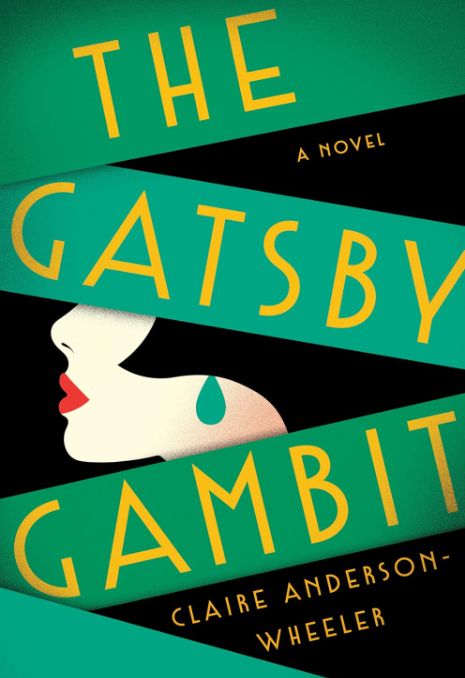
The title of this post is “Two Different Takes on Jay Gatsby”, and I wasn’t referring to the movies. Viking has just published The Gatsby Gambit by Claire Anderson-Wheeler, which is set in the same time and place as Fitzgerald’s novel, and features the same characters. However, that’s where any resemblance to The Great Gatsby ends. In The Gatsby Gambit, Jay Gatsby’s little sister, Greta, is the main character as she sets out to solve the mystery of Tom Buchanan’s death. Since Tom doesn’t die in The Great Gatsby, it’s clear that The Gatsby Gambit is not a sequel and doesn’t pretend to be. Rather it’s a nice little mystery, where we get to see the lives of the servants who work for Jay Gatsby, and how they are treated. Greta is a likeable character who has just returned from the “finishing school” Jay has sent her, and she is soon thrust into a situation where everyone around her could credibly be Tom’s murderer. Jay himself is portrayed as a man who came by his wealth honestly. Tom is worse than ever, and Anderson-Wheeler introduces us to his brother Edgar, who is even less attractive. Jordan and Nick stay fairly true to form, and Daisy is still mostly concerned with material things.

Once I realized that is wasn’t Anderson-Wheeler’s intention to write a sequel to Fitzgerald’s masterpiece (and, truth be told, who would want to?), I was able to relax and enjoy her tale. It will never be considered a classic, but it’s definitely an entertaining read, especially for readers familiar with The Great Gatsby.

Trollope’s Phineas Finn: Climbing the Ladder of Ambition

Phineas Finn is the second Anthony Trollope novel I’ve read (you can read my review of Can You Forgive Her? here), and the second in his Palliser series. In this novel, our hero, Phineas Finn, is a good natured, very attractive, and upstanding young man who is the son of an Irish country doctor. His father has paid his expenses while he studies under Mr. Low, a London barrister (lawyer). While dining at his club, young Finn is approached by his friend, Barrington Erle, and convinced to run for a seat in parliament for the borough of Loughshane. It’s a dead certainty he will win it, since there will be no serious opposition. The only problem is that members of parliament (MPs) do not get paid, and Phineas is entirely dependent on his father for his expenses!

Despite his father’s and Mr. Low’s very good arguments against running, Phineas decides to do it, and before he knows it, he is seated in Parliament. His longsuffering father agrees to continue his allowance until he can somehow figure out a way to pay his own way. Soon, he is swimming in the high society of London, but he manages to keep his head and remain humble. He becomes friends with another Irish MP, Laurence Fitzgibbon, a glib and somewhat dissolute young man who wastes no time convincing Finn to guarantee a bill for 250 pounds, assuring him that he will have the money in a couple of weeks, and there is nothing to worry about.

He also is befriended by Lady Laura Standish, who takes Phineas under her wing, because she sees such promise in him. She is another character of Trollope’s who illustrates the frustrating position upper class women in Victorian England were in: she is smart and well educated, and she has good ideas about what legislation should be passed by Parliament, but there is no way she can bring them to fruition, given she has no vote, let alone no way to run for parliament. Phineas is convinced he’s in love with Lady Laura and proposes to her, but she turns him down, because he is penniless, and she has given all of her money to her brother, Lord Chiltern, so he can settle some enormous debts he’s acquired through questionable life choices.

Lord Chiltern is a bit of a wild man – he despises social conventions and proper manners, preferring to spend his time hunting and traveling around England and Europe. He is in love with the beautiful Violet Effingham, who stands to inherit a large fortune when she marries. He has proposed to her three times (not very tactfully, it must be said), and she has flatly refused him because of his poor reputation and erratic behavior. To make things worse, Chiltern’s father has had nothing to do with him since his sister squandered her share of the family fortune to settle his obligations.

Lady Laura convinces Phineas to befriend Chiltern, in the hopes that he will be a moderating influence on him. They become friends, until Phineas meets Violet and decides he wants to marry her! The good friends become deadly rivals.

As a backdrop to all of this drama, Trollope chronicles all of the political intrigue involved in the passage of the Reform Bill of 1866. The reader is shown in exhausting detail how parliament works, and, by and large, it’s not pretty. What is interesting is how Finn, as a tyro MP, gradually gains confidence. At first, he is too terrified to even stand up and make a speech. Eventually, he finds his legs, and he becomes a trusted member of the Liberal party, led by the Prime Minister William Mildmay. Finn’s greatest asset is his ability to keep his mouth shut when necessary and to make pleasant conversation with the right people. Very soon, he is elevated to a paying position in the cabinet. Regardless of his rapid rise in society, he remains a very likeable character, due to his total lack of vanity.

As the novel progresses, Trollope uses various characters to illustrate different issues that were present in Victorian England. Phineas is an ambitious, yet talented and altruistic, young man from whose presence parliament would benefit, yet it is nearly impossible from him to affect legislation, even when he is made a government minister. The crisis of the novel occurs when he has to decide whether he will support a bill that will help his fellow Irish but goes against the policy of the governing party, of which he is a member. If he votes according to his conscience, he will be required to submit his resignation and lose his salary.

Lady Laura is the most tragic figure. Moments before Phineas proposes to her, she accepts Robert Kennedy’s offer of marriage. He is another MP, and one of the richest men in the UK. She feels that through him, she might be able to influence English politics. Unfortunately, Mr. Kennedy is an insufferable prig who insists Laura submit herself to the proper duties of a wife and have no independence at all. Their marriage degenerates to the point where they can barely communicate.

“Laura”, he said, “I am sorry that I contradicted you.”

“I am quite used to it, Robert.”

“No; – you are not used to it.” She smiled and lowered her head.
(ii, p. 109, Oxford Univ. Press Ed., 1991)

There is also a Madame Marie Goesler, a wealthy German widow, who moves in the highest circles of London society, but feels trapped by the fact that she can do nothing but attend parties and host them herself.

Phineas becomes very good friends with Joshua Monk, a “radical” MP who helps Phineas get his confidence during his first term in parliament. Mr. Monk, though, when he is offered and accepts a post in the government by the Liberals, loses his effectiveness as a debater, because he is forced to support the Liberals’ policies, even when he disagrees with them.

Trollope paints a fascinating and detailed picture of how politics worked in Victorian England. There was much frustration at the demands placed upon MPS to toe the party line, yet enforcing party discipline was the only way to get important legislation passed. Like today, opposing parties had to compromise, and everyone gave up something to get something in return. Near the end of the book, Monk’s and Finn’s bill to help Irish tenants fails on the second reading. Finn is dejected, but Monk makes this observation:

“Many who before regarded legislation on the subject as chimerical, will now fancy that it is only dangerous, or perhaps not more than difficult. And so in time it will come to be looked on as among the things possible, then among the things probable; – and so at last it will be ranged on the list of those few measures which the country requires as being absolutely needed. That is the way in which public opinion is made.”
(ii, p. 341)

Like almost all Victorian novels, Phineas Finn is long – 712 pages in the edition I read. However, it is an interesting complement to Charles Dickens’ David Copperfield, another tale of a self-made young man. While Dickens was the master of chronicling the travails and triumphs of England’s lower and middle classes, Trollope gives us accurate portraits of what it was like to move in the highest social strata of Victorian society. He isn’t afraid to point out the contradictions and injustices of the governing class, yet all of his characters are real. Phineas Finn is amazingly successful at first, but he has his flaws. His fellow MPs all exhibit human foibles – they each have good qualities as well as lesser ones. However, it’s the female characters that are the most fleshed out by Trollope – he has sincere sympathy for the plight they are in. They have very limited choices: either marry or be an “old maid”, but in neither case can a woman be an active political force. And once a young woman marries, she has no rights to any property or personal agency. If a young woman is due to inherit wealth, there is no guarantee she will be allowed to use it to live independently. However, lest one think Phineas Finn is all angst and frustration, Trollope sprinkles a lot of humor to leaven the drama. At heart, he loves his country and its people.

There are lots of free digital versions of Phineas Finn (you can download a nicely formatted one here.), but I really appreciated my Oxford University Press edition, because it had lots of helpful notes that explained the political events that were occurring at the time the novel is set in, as well as the meanings of slang phrases, references to other literary works, etc. I’ve read two of the six Palliser novels, so I guess I’d better get ready to tackle Phineas Redux next!