

Fitizgerald’s The Great Gatsby is deservedly a classic of American literature, some even claiming it is the greatest American novel ever written. It’s certainly a personal favorite – I’ve read it several times, and I picked it up to read once again. It was a rainy summer afternoon, and it’s short enough to read in one day. It’s rare that a novel captures an era as completely as Gatsby, and Fitzgerald is an outstanding writer. Every time I read it, I appreciate his talent more.
I was surprised to learn that on its initial release, it wasn’t a big success. In fact, it sold far less than its predecessor, The Beautiful and The Damned, and then sank into oblivion. It wasn’t until WWII that it became the hugely popular novel that it is. The US army was looking for some inexpensive titles it could print up and send to enlisted men, and The Great Gatsby filled the bill. When the soldiers returned home, they talked about a terrific book they read while serving overseas, and enough interest was generated to reignite the novel’s popularity. (You can read a more detailed account of Gatsby’s resurrection here.)
What I love about The Great Gatsby is how Fitzgerald doesn’t waste a single word. It’s the very American tale of a self-made man who is the victim of his naive belief that if he only has enough wealth, he can accomplish anything, to the point of erasing the recent past and reliving it on his terms.
It’s a masterstroke of Fitzgerald that we never really know exactly how Jay Gatsby amassed his enormous fortune – bootlegging, illicit drugs, gambling – who knows? He does acquire a huge mansion on West Egg, Long island, and hosts extravagant parties with one single purpose: to reconnect to his true love: Daisy Buchanan. And here is one of my favorite passages in the novel: when narrator Nick Carraway visits the Buchanan’s (he is Daisy’s second cousin), they sit down to dinner, and Daisy exclaims,
‘Why candles?’ objected Daisy, frowning. She snapped them out with her fingers. ‘In two weeks it’ll be the longest day in the year.’ She looked at us all radiantly. ‘Do you always watch for the longest day of the year and then miss it? I always watch for the longest day in the year and then miss it.’
F. Scott Fitzgerald. The Great Gatsby (Kindle Locations 274-276).
In just a few brief sentences, Fitzgerald indelibly portrays who Daisy is as a person: her aimlessness and superficiality. Her husband, Tom, is a philandering blowhard who quotes the latest “scientific” books he’s read, but he has no idea what he’s talking about. Their friend, Jordan Baker, whom Nick initially falls for, is a semiprofessional golfer who isn’t above cheating when it benefits her game.
Nick, a beginning bond trader, lives next door to Gatsby, and he hangs on to his principles, even when Gatsby offers him a lucrative business opportunity. Carraway turns him down, more interested in being Gatsby’s friend and figuring who he really is beneath the facade. Once Gatsby learns that Nick has a personal connection to Daisy, he asks Nick to help him reconnect with her. His long quest is about to come to fruition!
Unfortunately, that quest involves resetting his and Daisy’s life back to when he first courted her as a young soldier about to go off to Europe in WWI. As far as he’s concerned it’s not too much to ask Daisy to deny that she ever loved Tom and start life anew with him, even though Daisy and Tom have a three-year-old daughter. Nick tries to talk some sense to Gatsby,
‘I wouldn’t ask too much of her,’ I ventured. ‘You can’t repeat the past.’
‘Can’t repeat the past?’ he cried incredulously. ‘Why of course you can!’
He looked around him wildly, as if the past were lurking here in the shadow of his house, just out of reach of his hand.
‘I’m going to fix everything just the way it was before,’ he said, nodding determinedly. ‘She’ll see.’
F. Scott Fitzgerald. The Great Gatsby (Kindle Locations 1489-1493).
If you haven’t read The Great Gatsby, do yourself a favor and pick it up! It’s a devastating indictment of the idle rich and the bubble they live in. Nick observes near the end of the story,
They were careless people, Tom and Daisy — they smashed up things and creatures and then retreated back into their money or their vast carelessness, or whatever it was that kept them together, and let other people clean up the mess they had made . . .
F. Scott Fitzgerald. The Great Gatsby (Kindle Locations 2368-2370).
As I mentioned, it’s relatively short, and every word counts. It has been adapted to film several times, the two most significant are one in 1974 starring Robert Redford as Gatsby and Mia Farrow as Daisy, and the other from 2013 starring Leonardo DiCaprio and directed by Baz Luhrmann. The former is one of the most faithful adaptations of a novel I’ve ever seen, with every character perfectly cast. The Luhrmann one is obnoxious to my tastes, featuring contemporary hip hop music and an unsettling, disjointed film technique. Snatches of dialogue come and go and are lost in the din of the noisy soundtrack.
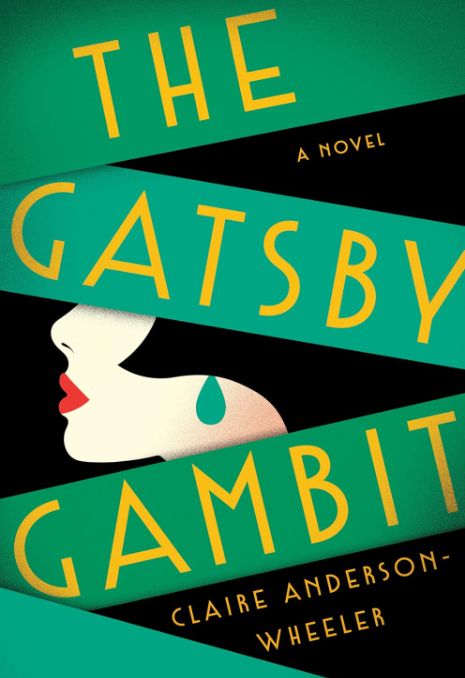
The title of this post is “Two Different Takes on Jay Gatsby”, and I wasn’t referring to the movies. Viking has just published The Gatsby Gambit by Claire Anderson-Wheeler, which is set in the same time and place as Fitzgerald’s novel, and features the same characters. However, that’s where any resemblance to The Great Gatsby ends. In The Gatsby Gambit, Jay Gatsby’s little sister, Greta, is the main character as she sets out to solve the mystery of Tom Buchanan’s death. Since Tom doesn’t die in The Great Gatsby, it’s clear that The Gatsby Gambit is not a sequel and doesn’t pretend to be. Rather it’s a nice little mystery, where we get to see the lives of the servants who work for Jay Gatsby, and how they are treated. Greta is a likeable character who has just returned from the “finishing school” Jay has sent her, and she is soon thrust into a situation where everyone around her could credibly be Tom’s murderer. Jay himself is portrayed as a man who came by his wealth honestly. Tom is worse than ever, and Anderson-Wheeler introduces us to his brother Edgar, who is even less attractive. Jordan and Nick stay fairly true to form, and Daisy is still mostly concerned with material things.
Once I realized that is wasn’t Anderson-Wheeler’s intention to write a sequel to Fitzgerald’s masterpiece (and, truth be told, who would want to?), I was able to relax and enjoy her tale. It will never be considered a classic, but it’s definitely an entertaining read, especially for readers familiar with The Great Gatsby.
 FracTad's Bookshelf