
Kurt Schlichter’s and Irina Moises’ Lost Angeles: Noir, Humor, and Fantasy Combined

Kurt Schlichter, author of the excellent People’s Republic/Kelly Turnbull novels, has just released a new book co-written with his wife Irina Moises, Lost Angeles: Silver Bullets On The Sunset Strip. Perfect timing, since it is an homage to the pulp noir detectives Dashiell Hammett and Raymond Chandler wrote about in the 1930s and 40s, and I recently read Chandler’s The Lady In The Lake.

Schlichter’s and Moises’ detective is Eddie Loud, and he is obviously modeled on Chandler’s Philip Marlowe. He’s tough and wisecracking, while struggling to live up to his moral code. However, things get really weird, really fast. Set in 1940 Los Angeles, Loud specializes in cases involving “demigods” – people who are part divine and virtually immortal. In the universe of Lost Angeles, the ancient Greek gods exist. However, with the advent and rise of Christianity, these “demigods” have retreated into an uneasy truce with mortals, rarely being seen in public. The male ones, like Apollo, Zeus, and Poseidon, occasionally sleep with a mortal, sometimes creating an immortal. Half-breeds are truly immortal, but quarter-breeds can be killed with a silver bullet or other weapon. With less than 1/64 divine blood, they’re basically mortal humans.

The case in this story involves a rare half-breed, Charles Gaultier, who has been kidnapped. His majordomo, Constance Showers, hires Loud to find him. As he begins his investigation, he is soon thrown together with another private investigator, Trixie Gamble, a gorgeous woman who traces her lineage back to Cassandra of Troy. Millennia ago, Apollo fell in love with Cassandra and bestowed on her the gift of prophecy. However, she spurned him, and in revenge he cursed her to be able to foretell the future, but never be believed. Trixie has inherited this gift/curse, and the results are hilarious.

Trixie offered to give me a ride in her little red convertible. I told her that if anybody saw me sitting in the passenger seat, they would think I was a swish. She got that faraway look in her eyes and said that someday most men wouldn’t mind that. I laughed. She was always saying crazy things.

Schlichter, Kurt; Moises, Irina. Lost Angeles: Silver Bullets On The Sunset Strip (p. 44). Kindle Edition.

“The question is who tipped them off we were on the case. Dufrasne?”

“Maybe Goldman,” Trixie said. “He should have listened to me. But regardless, we’re on the Nazis’ radar now.”

“Their what?” I asked, baffled.

“I don’t know what that means,” Trixie said, confused.

Schlichter, Kurt; Moises, Irina. Lost Angeles: Silver Bullets On The Sunset Strip (p. 69). Kindle Edition.

Vivien Leigh’s pic was staring down from the wall into my tomato bisque. Across the way, the genuine article was nibbling on a lobster salad when she wasn’t berating her fiancé, Laurence Olivier, about something. The tabloids were calling her a homewrecker for stealing him away from his wife.

“She doesn’t seem to care much about the scandal,” I observed to Trixie.

“You don’t have to when you just won Best Actress,” Trixie replied. Leigh had picked up a little naked gold man for Gone With the Wind.

“Hooray for Hollywood,” I said and slurped a spoonful of soup.

Trixie got that strange, far-away look again. “Someday, a man will be nominated for Best Actress. He might even win.”

I about spit out my mouth full.

Schlichter, Kurt; Moises, Irina. Lost Angeles: Silver Bullets On The Sunset Strip (p. 71). Kindle Edition.

Trixie is on a similar case, trying to find out where a demigod has disappeared to. His mortal lover has hired her. Unfortunately, she found him dead, in the trunk of a car, which is supposed to be impossible. Before she could figure out how that happened, the FBI showed up and whisked the body away.

So, Trixie and Eddie decide to team up and get to the bottom of who kidnapped Charles Gaultier and why. Before too long, they are tangling with German and American Nazis (remember, this is set in 1940, just before the US entered WWII), Hollywood and Russian communists, and mobsters. It’s all a lot of fun, with tons of Schlichter’s trademark sense of humor. He and Irina have dropped dozens of Easter eggs throughout the book. Here are a couple of examples:

As she finished her Dewars, I counted the bills. “Trust but verify” is my motto. I picked it up at The Trocadero one night when I overheard Ronald Reagan saying it to Jane Wyman at the next table.

Schlichter, Kurt; Moises, Irina. Lost Angeles: Silver Bullets On The Sunset Strip (p. 18). Kindle Edition.

Others gambled at tables set up along the walls. As we passed, a satyr dealt a blackjack to John Wayne. Clarke Gable, sadly, busted after being dealt a king on his twelve showing. He shrugged, frankly not giving a damn.

Schlichter, Kurt; Moises, Irina. Lost Angeles: Silver Bullets On The Sunset Strip (p. 157). Kindle Edition.

There’s even a reference to “Captain Geech and the Shrimp Shack Shooters”, a fictional beach movie band that was in the Tom Hanks movie, That Thing You Do.

In one respect, Loud is very different from Philip Marlowe: he has no hesitation using his gun, and in practically every scene he and Trixie leave behind a trail of carnage. The fact that the dead bodies are all Nazis and Commies makes it acceptable, though!

As the story works its way up to the climax involving the Nazis, the Soviets, the FBI, and the Mob, Schlichter and Moises engage in some interesting conjecture: what, exactly would it be like to be immortal? Would it be a blessing or a curse? They make a very good case that living forever among mortals would be the latter.

In the Afterword, Schlichter and Moises assure us that this is the first book in a projected series, which I think is great news. Lost Angeles: Silver Bullets on the Sunset Strip is a very entertaining read, and I love all the digs they get in at contemporary Hollywood culture. I was laughing out loud at several jokes, and the plot is very engaging. It’s a perfect mix of gritty noir and fantasy. Highly recommended if you are looking for a modern spoof of classic noir fiction.
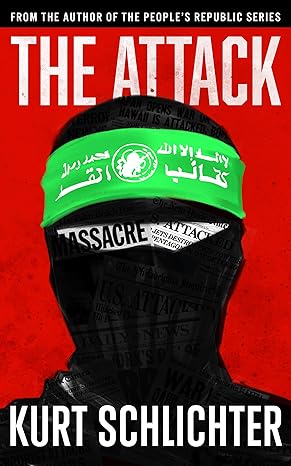
The Attack: Could It Happen Here?

Attack

I’ve been a fan of Kurt Schlichter’s writing since the first Kelly Turnbull thriller, People’s Republic. That one was a fast-paced, funny tale of a future America that had split into a “Blue” country (the People’s Republic of North America) and a “Red” one. Schlichter used it and the following seven novels in the series to hilariously skewer the pretensions and contradictions in wokism when carried to its extreme. However, he was careful to state at the beginning of each book that he certainly wasn’t hoping for a civil war or even an amicable split, but rather he was warning us of the dangers of what could result if that happened.

Schlichter’s latest book is not a Kelly Turnbull adventure, but rather a sobering – no, make that extremely frightening – account of a massive terrorist attack on the United States in the very near future (the attack occurs August 27 – 29, 2024). Schlichter wrote it not long after the Hamas attack on Israel, and it was available on Amazon in early January; that must be a record for writing a full-length novel and getting it out to the public!

It is an oral history – 40 brief chapters that consist of the testimonies of a wide variety of people. Military officers, a cop in Cincinnati, a gay Texan and his new friend from the neighborhood Church of Christ, EMTs, a TV news reporter, an HVAC company owner, a traumatized 15-year-old girl, a Chinese spy who defected to the U.S., a progressive defense lawyer, a former Mexican cartel leader, a right-of-center economics professor, and a House Speaker from Louisiana who ends up being president for 44 critical days are a few of the people the author “interviews” five years after The Attack.

The voices in the story come from many backgrounds and have such different levels of authority, which creates an undeniable sense of authenticity. That is the overriding impression I got while reading – the premise of the book is so plausible. That’s also what makes it so frightening. If October 7 could happen in Israel, then this scenario could just as easily happen to us.

The Attack itself is a three-day rampage carried out by thousands of jihadis who have slipped into the country via our wide-open southern border. They are mostly in cells of four or five, and no one cell has any idea that there are others. Only a few in leadership are aware of the overall plan.

On Day One, August 27, public places are hit at noon, EDT. Crazed jihadis hit hospitals, malls, airports, schools, and other high-density targets. They are armed with AK-47s, grenades, and IEDs. Across the country, from Hawaii to Maine, tens of thousands of Americans are slaughtered. Law enforcement is quickly overwhelmed (at least the officers who survive the initial bombings of police stations). The jihadis are so hopped up on hatred and meth, they don’t stop killing until they are killed.

The White House itself is attacked, and while the President is being hustled downstairs to his bunker he falls and breaks his hip. After the Day One terrorists are neutralized, everyone thinks it’s over. The Vice-President refuses to come out of her office, but her aides convince her to give a TV address to the nation. Predictably, it’s a disaster (any resemblance to an actual person is purely intentional):

I know that many Americans are feeling many feelings today – sadness, hope, even joy in our shared experience as Americans experiencing a situation. To those of you who have lost loved ones, we are sorry for your losses and we grieve with you. But what is lost can be found again in the kingdom of our hearts. We must embrace, laugh, smile, and dance. This will show the people who caused us such grief that our unbroken spirit remains unbroken and that they cannot break it.

It is important to not forget that those who have suffered so much include indigenous peoples, black and brown Americans, those who reject the gender binary and those who embrace the beautiful rainbow of identities that arches above our country.

Understand that there will be accountability for these events, and that the people responsible will be held to their responsibility for the crimes they are responsible for.

Schlichter, Kurt. The Attack (p. 155). Kindle Edition.

On August 28, all of the authorities are busy securing the public areas, and they tell everyone to stay at home. That’s when thousands more terrorist cells emerge and target residential areas. This was the most difficult section to read, as various witnesses recount the atrocities the Islamists inflicted on families who, for the most part, had no way to protect themselves and their families.

This is also the day that the Antifa types and campus radicals get involved, helping to transport jihadi cells in their cars and confusing responders by calling in false 911 reports. One of the interviewees is a young woman who participated in BLM riots and was eager for “the revolution”. As she explains, there had never been any consequences for her previous antisocial behavior:

We would be indulged, treated gently, patted on the head and allowed to go free only to repeat our actions again and again. It never occurred to us that the people we called “fascists” and “oppressors” might not treat us with kid gloves. Of course, most of us had grown up never being told “No.”

Schlichter, Kurt. The Attack (p. 183). Kindle Edition.

Day Three is when there is a coordinated attack on power stations, oil refineries, the internet, and other critical infrastructure. The supply chain breaks down with the resulting social unrest.

Believe it or not, Schlichter is optimistic about our ability to survive and retaliate. The temporary President (he agrees to only serve until the next election, which is a little more than two months away) imposes martial law with Congress’ approval. He eliminates all bureaucratic red tape that might prevent new refineries from getting built and other infrastructure repaired. There is a brief period of food and gas rationing. He authorizes the government to shut down the border and deport millions of illegal aliens. And there are other military responses that happen, but I won’t spoil it for you.

Despite the dark subject matter, Schlichter cannot resist throwing in some very funny passages. One of the interviewees is a Silicon Valley Tech Bro, and here he describes his latest venture:

My current start-up was Leftoverture. It was an app that used proprietary AI to match people with leftovers and facilitate some guy using his car to make the exchange. Say you cooked lasagna and had half a pan left but wanted something else for dinner the next night. Leftoverture solved that problem. It identified other leftover holders, let you choose what you wanted, and facilitated the trade. Our slogan was “Second day is not second best.” Leftoverture was my contribution to mankind.

Schlichter, Kurt. The Attack (p. 87). Kindle Edition.

And here is a dig at the FBI:

In fact, the rumors are true – later, the investigation found that the terrorists had considered hitting the J. Edgar Building with an AMFO truck bomb day one, like they did in Vegas and elsewhere, but they made a conscious decision not to because they thought the FBI would do more damage to the American response if it was fully operational.

Schlichter, Kurt. The Attack (pp. 147-148). Kindle Edition.

And this is from a Hollywood executive:

I was at work the first day of the Attack, getting ready to go to a breakfast meet with a producer who allegedly had a star attached – she was a “tentative maybe” – for a feminist reboot of Dirty Harry. That was a nonstarter – audience appeal aside, I just did not feel Emma Stone for the lead.

Schlichter, Kurt. The Attack (p. 71). Kindle Edition.

The Attack is a warning about a threat that I sincerely hope our government is aware of. I’ll leave you with one more quote:

The power and prosperity of the West not only kept its people safe but created space to indulge the sophomoric notion that all people thought like, and aspired to be like, the West. But that is not true. It never was.

Schlichter, Kurt. The Attack (p. 33). Kindle Edition.