John Kennedy’s How To Test Negative For Stupid

A friend gave me this book for Christmas. I don’t usually read books by politicians, but How to Test Negative for Stupid by Senator John Kennedy (R, Louisiana) is one of the funniest and entertaining memoirs I’ve read in a long time. He is definitely one of a kind, known for the very humorous quips and questions he makes during Senate hearings. He has a thick Southern drawl, which can lead an unsuspecting witness or nominee to underestimate him, but he is smart as a whip.

Practically every page has a laugh-out-loud passage:

For as long as I can remember, one thing has been true about me: I have the right to remain silent, but not the ability. (Page 1)

Most Americans imagine the Senate as this grand theater filled with distinguished lawmakers delivering erudite speeches. In reality, it’s usually empty as a timeshare salesman’s heart. (Page 13)

I observed to a reporter one time that you can lead a person to Congress, but you can’t make him think. (Page 21)

I’ve never heard either Susan [Collins] or Jeanne [Shaheen] raise her voice. Composure is their super power. They are as polite as they are effective. Imagine a cross between a hall monitor and a class valedictorian. I honestly believe that Susan and Jeanne think WTF stands for Well, That’s Fantastic. (Page 22)

“Thom [Tillis] may not like my bill, but I still think he’s a good man. He has many friends, including me. Let me tell you what one of Thom’s childhood friends said about Thom’s first sexual experience. Thom was thirteen. It was night. It was dark. He was nervous. He was scared. And he was alone.” (Page 26)

That’s Lindsey [Graham] – unafraid and able to talk the hinges off a gate. That doesn’t mean he’s always right. Sometimes I think his motto is “Don’t be part of the problem – be the whole problem.” But he’ll say the quiet part out loud, and I respect that. He’s also unpredictable. Invite him to dinner, and you don’t know if he’ll sit  down for an intelligent conversation or get drunk and vomit in the fish tank. But that’s why I like him. (Page 14)

Even though Kennedy is a Republican, he began his political career as a Democrat, and he doesn’t let party loyalty get in the way of his principles. One thing that comes through loud and clear is his desire to cut through Washington D.C. BS and make sure the federal government serves the American people.

As Kennedy relates the high points of his life, we learn about his growing up in the small town of Zachary, LA, his time at Vanderbilt University as an undergraduate, then UVA Law School, as well as some graduate work at Oxford. I have to quote him on when he first arrived at Vandy (my own alma mater, BTW):

   Then and now, Vanderbilt ranks as one of the top American universities. So many people I met there seem to have attended private school. This made no sense to me. Back in Zachary, everyone went to a public school. The only reason you’d go to a private school was if you were a badass who kept getting in trouble. That would get you sent to a private military academy that was supposed to straighten you up and teach you discipline. March to class and do push-ups and that kind of stuff. So, as I walked around the campus of my new college, meeting people who went to private schools with names like Woodberry Forest, Montgomery Bell Academy, and Phillips Exeter, I remember being shocked.
“My God, ” I thought, “I’m going to school with a bunch of juvenile delinquents. They must have turned themselves around in military academy to get into Vanderbilt.” (Page 41)

Some of the most interesting passages involve Sen. Kennedy’s interactions with Pres. Trump. He gets along well with Trump, but he isn’t in awe of him. He understands that Trump likes to take credit for successes, even when it isn’t warranted, and he supports Trump’s attempts to reform “The Swamp”.

Kennedy also gives the reader a glimpse into the Byzantine workings of the US Senate, providing a few of his “greatest hits”, viral moments from various hearings. He wraps up How to Test Negative for Stupid with a speed round: his thoughts on various issues like immigration, the media, crime, etc. If he has a consistent ideology, it’s basically libertarian: it’s the job of the government to provide a safe place for Americans to live, work, and worship as they see fit. The lower the taxes and the fewer the regulations, the better off we all are.

Regardless of your political leanings, How to Test Negative for Stupid is a very entertaining read, and it gives me hope knowing there are men like John Kennedy in the Senate. He’s not afraid to say what he thinks, whether it angers Republicans or Democrats. He marches to his own drummer, and I respect him for that.

Paul Johnson’s Modern Times: The Best of Times, The Worst of Times

I read Paul Johnson’s Modern Times when he published his Revised Edition in 1991. I liked it very much, and I appreciated his heterodox takes on the events of the twentieth century that went against conventional opinion. I decided to reread it and see if it held up after more than three decades. I think it does, but I found it more depressing than I remembered it being the first time I read it.

Johnson begins his history with the scientific verification of Einstein’s General Theory of Relativity. On May 29, 1919, photographs of a solar eclipse confirmed Einstein’s predictions of light “bending” due to gravitational pull. From this successful experiment, Newton’s description of a deterministic universe governed by mechanical laws was rendered obsolete. Johnson uses this event to put forward his thesis that the turmoil and carnage of the twentieth century resulted from a loss of belief in absolutes – in other words, moral relativism ruled the day.

Over and over again, he makes the case that the horrors of Leninism, Stalinism, Nazism, fascism, and other twentieth century ideologies were simply moral relativism taken to its logical extremes. Even the “good guys” – the Allied Powers that defeated Germany and Japan in WWII, succumbed to moral relativism and committed terrible acts, such as the firebombing of Dresden – an act of war that would have been inconceivable in the nineteenth century.

What makes Modern Times such an excellent work is its comprehensive reach; it truly is a world history. While Johnson carefully chronicles the struggles of Europe to recover from WWI, he also spends as much time explaining the agonies China was undergoing at the same time, and how Japan became the belligerent power that thought it could take on the United States. He also devotes many pages to how Africa fared as the colonial powers left and the African nations tried to build workable governing systems.

Even though Johnson is British, he is not afraid to criticize his country when that criticism is justified. Here’s how he describes the British Empire during the interwar era:

There is a vital moral here. Britain could be just to her colonial subjects so long as she was a comparatively wealthy nation. A rich power could run a prosperous and well-conducted empire. Poor nations, like Spain and Portugal, could not afford justice or forgo exploitation. But it follows from this, as many British statesmen had insisted throughout the nineteenth century, that colonies were not a source of strength but of weakness. They were a luxury, maintained for prestige and paid for by diverting real resources. The concept of a colonial superpower was largely fraudulent. As a military and economic colossus, the British Empire was made of lath and piaster, paint and gilding.

Johnson, Paul. Modern Times Revised Edition: The World from the Twenties to the Nineties (p. 239). HarperCollins. Kindle Edition.

He also has a sarcastic wit, as exemplified by this opening sentence of Chapter 5: An Infernal Theocracy, a Celestial Chaos:

While Winston Churchill was assuring the comatose Baldwin that Japan meant no harm, its economy was growing at a faster rate than any other nation, its population was rising by a million a year and its ruler was a god-king who was also insane.

Johnson, Paul. Modern Times Revised Edition: The World from the Twenties to the Nineties (p. 260). HarperCollins. Kindle Edition.

Another theme that emerges as the reader is guided through the twentieth century is how often missed opportunities led to disaster. Of course, hindsight is 20/20, but there are times when it is hard to believe people in positions of power didn’t see what was in front of them. Johnson explains it this way:

If the decline of Christianity created the modern political zealot–and his crimes–so the evaporation of religious faith among the educated left a vacuum in the minds of Western intellectuals easily filled by secular superstition. There is no other explanation for the credulity with which scientists, accustomed to evaluating evidence, and writers, whose whole function was to study and criticize society, accepted the crudest Stalinist propaganda at its face value. They needed to believe; they wanted to be duped.

Johnson, Paul. Modern Times Revised Edition: The World from the Twenties to the Nineties (p. 404). HarperCollins. Kindle Edition.

I mentioned that Johnson often goes against “received wisdom” when it comes to history, and a case in point is his championing of the Warren Harding presidency that followed Woodrow Wilson’s. I know from my own high school experience that I was taught Wilson was an exceptionally good president with many wonderful accomplishments to his credit, while Harding was one of the worst with a corrupt administration. After reading Johnson’s account, I’m much more likely to give Harding credit for allowing the America to grow and develop without government meddling.

Another eye-opening section is Johnson’s explanation of the roots of the seemingly never-ending conflicts in the Middle East.

In 1921 they [Britain} authorized a Supreme Muslim Council to direct religious affairs; and it appointed Mohammed Amin al-Husseini, head of the biggest landowning clan in Palestine, to be senior judge or Mufti of Jerusalem for life. It was one of the most fatal appointments in modern history. … The Mufti outrivalled Hitler in his hatred for Jews. But he did something even more destructive than killing Jewish settlers. He organized the systematic destruction of Arab moderates. There were many of them in 1920s Palestine. Some of them even welcomed Jewish settlers with modern agricultural ideas and sold land to them. Arabs and Jews might have lived together as two prosperous communities. But the Mufti found in Emile Ghori a terrorist leader of exceptional ability, whose assassination squads systematically murdered the leading Arab moderates–the great majority of the Mufti’s victims were Arabs–and silenced the rest. By the end of the 1930s Arab moderate opinion had ceased to exist, at least in public, the Arab states had been mobilized behind Arab extremism, the British Foreign Office had been persuaded that continued access to oil was incompatible with continued Jewish immigration, and the 1939 White Paper virtually brought it to an end and, in effect, repudiated the Balfour Declaration: ‘a gross breach of faith’, as Churchill put it.

Johnson, Paul. Modern Times Revised Edition: The World from the Twenties to the Nineties (pp. 703-704). HarperCollins. Kindle Edition.

As the twentieth century progressed, Johnson laments the rise of the “professional politicians” – men who never worked at any job except running for office, and as a result have no idea how to start and maintain a small business, run a farm, distribute goods efficiently, or protect property. It’s a sad fact that today we take it for granted that nearly all of our elected representatives these days come from this professional politician class.

Modern Times concludes with a long chapter that covers the mid-eighties to the early nineties. It’s bittersweet to read how optimistic Johnson was after the successful alliance that expelled Saddam Hussein’s Iraqi forces from Kuwait. He thought the world had learned from the mistakes it made in the twentieth century, and a new era of turning away from government-led solutions of society’s ills to individual empowerment was dawning. Despite that not exactly materializing, Modern Times is a clear-eyed account of an amazing century. It saw the invention of the electric light bulb, radio, television, airplanes, nuclear power, microchips, and home computers. There were incredible discoveries in medicine. The per capita wealth of the entire planet began to rise rapidly. Life expectancy made huge gains. Communism rose and fell. And yet, it was also the deadliest century in humanity’s history. Hundreds of millions of people were killed by their own governments or in wars. Let’s hope the twenty-first century avoids that fate.

Brendan O’Neill’s A Heretic’s Manifesto – Essays on the Unsayable

Heretic

Book #28 of 2024

British writer and pundit Brendan O’Neill is one of the founders of the website Spiked, where he and others regularly post countercultural observations. His book, A Heretic’s Manifesto, consists of ten essays on topics that, according to woke orthodoxy, should never be discussed or questioned. It is an impassioned protest against “cancel culture”, and the threat it poses to free speech.

In Chapter 1, Her Penis, O’Neill points out the absurdity of the trans movement that insists a man can be woman or a woman can be a man, simply by wishing it so. “In being compelled to say she/her about men, to accept that there’s an inner gender and an outer sex and sometimes they are mismatched, we are being compelled to convert to a new religion. The religion of gender fluidity. The religion of gendered souls. Such ‘encouraged’ conversion runs entirely counter to the Enlightenment itself and to the freedom of conscience it promised humankind.” (p. 11)

Chapter 2, Witch-Finding, explains how, since at least medieval times, unusual weather phenomena has been blamed on human agency. In 1599/1600, there was a Little Ice Age, and women were accused of being witches and controlling the weather. Nowadays, we use science to blame humanity for climate change. However, “when it comes to climate change, we’re not really talking about science. We’re talking about scientism. We’re talking about the use of science to fortify political agendas. We’re talking about the way the technocratic elites now marshal expertise in their fearful moral favour.” (p. 31)

Covid as Metaphor details the damage done to well-functioning communities by the lockdowns, mask mandates, and other authoritarian measures that ended up doing more harm than good.

Islamocensorship illustrates the paradox of how thousands of Muslims in Iran protest against the law that requires women to wear a hijab, yet in the West, it is considered Islamophobic to say that the hijab is oppressive to women. Western governments have enforced language policies that prevent a free exchange of ideas. “So don’t say Islamic terrorism. Or Muslim fundamentalism. Don’t say Islam is intolerant. Don’t say ayatollahs use their religion for strategic gain. These are expressions of ‘phobic dread’. This isn’t anti-racism. It is a naked effort to circumscribe public commentary on Islam.” (p. 61)

Rise of the Pigs refers to a British tendency to label political opponents “gammon”, “swine”, and other porcine nouns. It began with Edmund Burke, who wrote of his fear of the “swinish multitude” in his Reflections on the Revolution in France. Lately, these insulting labels have been applied to the supporters of Brexit.

White Shame discusses how the BLM riots during the summer of 2020 represented a turning point in race relations. “One of the most chilling things in the cult of white self-abasement was the collectivisation of guilt for the killing of George Floyd. It wasn’t only that white cop, Derek Chauvin, who was culpable for that dreadful crime – all whites were.” (p. 92)

The Love That Dare Not Speak Its Name is an interesting take on LGBT rights. O’Neill posits that the militant trans rights movement is like conversion therapy for the 21st century. If a young woman is attracted to other women, she can’t be a lesbian, she must be a trans man! In other words, the “T” in LGBT is erasing the “L”, “G”, and “B”, because they proclaim that there are biological differences between men and women.

Viva Hate is concerned with the incredible vitriol and hate author J. K. Rowling has endured, due to her insistence that men cannot be women, and vice versa. O’Neill points out that the more a culture tries to eliminate hate speech, the more hate spreads. “The crusade against hate actually gives us a warrant to hate. It gives us a license to loathe. Through continually indicating which ideas it is no longer acceptable for people to hold, whether that’s the idea that men cannot become women or that same-sex marriage is immoral or that Islam is regressive, hate-speech strictures invite us to attack those ideas and, by extension, the people who hold them.” (p. 132)

The Pretenders is a humorous cataloging of all the white, middle and upper class individuals who have posed as members of indigenous or black people. “Nothing speaks more profoundly to the crisis of identity than that phrase, ‘I identify as…’. In the past, we were. You didn’t identify as something, you just were that thing….There was a confidence, a certainty, to people’s sense of identity, and to their declarations of that identity.” (p. 153)

In the concluding chapter, Words Wound, O’Neill argues against the tendency of civil libertarians to counter arguments for censorship by saying mere words cannot hurt people. “Words do destabilise, they do disorientate. People are right to sometimes feel afraid of words. Words are dangerous. When they say words wound, we should say: ‘I agree.’
But here’s the thing: it is precisely because words can wound, precisely because of their power to unsettle, that they should never be restricted. It is precisely the unpredictable energy and influence of speech that means it must be put beyond the jurisdiction of all earthly authorities. Because nothing that empowers the individual to such an extant that it allows him to sow and spread ideas that might one day change society for the better should ever be constricted.” (p. 162)

The example O’Neill uses is that of William Tyndale (1494 – 1536), who risked life and limb to translate the Bible into English. He believed that ordinary people had the right to read it for themselves and make up their own minds, without the Church deciding what could and could not be heard. Something we take for granted – the ready availability of the Bible in our language – was something Tyndale was killed for.

A Heretic’s Manifesto is a plea for protecting and expanding free speech and expression, as opposed to the forces of woke oppression and censorship. O’Neill provides ten powerful examples of how free speech is threatened by governmental and cultural authorities today. As Europe processes the results of the latest EU elections, this book has some good explanations of why they went the way they did. Could the same thing happen in the US?

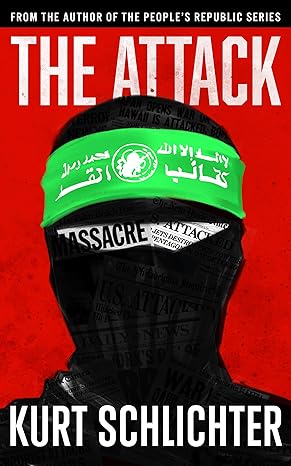
The Attack: Could It Happen Here?

Attack

I’ve been a fan of Kurt Schlichter’s writing since the first Kelly Turnbull thriller, People’s Republic. That one was a fast-paced, funny tale of a future America that had split into a “Blue” country (the People’s Republic of North America) and a “Red” one. Schlichter used it and the following seven novels in the series to hilariously skewer the pretensions and contradictions in wokism when carried to its extreme. However, he was careful to state at the beginning of each book that he certainly wasn’t hoping for a civil war or even an amicable split, but rather he was warning us of the dangers of what could result if that happened.

Schlichter’s latest book is not a Kelly Turnbull adventure, but rather a sobering – no, make that extremely frightening – account of a massive terrorist attack on the United States in the very near future (the attack occurs August 27 – 29, 2024). Schlichter wrote it not long after the Hamas attack on Israel, and it was available on Amazon in early January; that must be a record for writing a full-length novel and getting it out to the public!

It is an oral history – 40 brief chapters that consist of the testimonies of a wide variety of people. Military officers, a cop in Cincinnati, a gay Texan and his new friend from the neighborhood Church of Christ, EMTs, a TV news reporter, an HVAC company owner, a traumatized 15-year-old girl, a Chinese spy who defected to the U.S., a progressive defense lawyer, a former Mexican cartel leader, a right-of-center economics professor, and a House Speaker from Louisiana who ends up being president for 44 critical days are a few of the people the author “interviews” five years after The Attack.

The voices in the story come from many backgrounds and have such different levels of authority, which creates an undeniable sense of authenticity. That is the overriding impression I got while reading – the premise of the book is so plausible. That’s also what makes it so frightening. If October 7 could happen in Israel, then this scenario could just as easily happen to us.

The Attack itself is a three-day rampage carried out by thousands of jihadis who have slipped into the country via our wide-open southern border. They are mostly in cells of four or five, and no one cell has any idea that there are others. Only a few in leadership are aware of the overall plan.

On Day One, August 27, public places are hit at noon, EDT. Crazed jihadis hit hospitals, malls, airports, schools, and other high-density targets. They are armed with AK-47s, grenades, and IEDs. Across the country, from Hawaii to Maine, tens of thousands of Americans are slaughtered. Law enforcement is quickly overwhelmed (at least the officers who survive the initial bombings of police stations). The jihadis are so hopped up on hatred and meth, they don’t stop killing until they are killed.

The White House itself is attacked, and while the President is being hustled downstairs to his bunker he falls and breaks his hip. After the Day One terrorists are neutralized, everyone thinks it’s over. The Vice-President refuses to come out of her office, but her aides convince her to give a TV address to the nation. Predictably, it’s a disaster (any resemblance to an actual person is purely intentional):

I know that many Americans are feeling many feelings today – sadness, hope, even joy in our shared experience as Americans experiencing a situation. To those of you who have lost loved ones, we are sorry for your losses and we grieve with you. But what is lost can be found again in the kingdom of our hearts. We must embrace, laugh, smile, and dance. This will show the people who caused us such grief that our unbroken spirit remains unbroken and that they cannot break it.

It is important to not forget that those who have suffered so much include indigenous peoples, black and brown Americans, those who reject the gender binary and those who embrace the beautiful rainbow of identities that arches above our country.

Understand that there will be accountability for these events, and that the people responsible will be held to their responsibility for the crimes they are responsible for.

Schlichter, Kurt. The Attack (p. 155). Kindle Edition.

On August 28, all of the authorities are busy securing the public areas, and they tell everyone to stay at home. That’s when thousands more terrorist cells emerge and target residential areas. This was the most difficult section to read, as various witnesses recount the atrocities the Islamists inflicted on families who, for the most part, had no way to protect themselves and their families.

This is also the day that the Antifa types and campus radicals get involved, helping to transport jihadi cells in their cars and confusing responders by calling in false 911 reports. One of the interviewees is a young woman who participated in BLM riots and was eager for “the revolution”. As she explains, there had never been any consequences for her previous antisocial behavior:

We would be indulged, treated gently, patted on the head and allowed to go free only to repeat our actions again and again. It never occurred to us that the people we called “fascists” and “oppressors” might not treat us with kid gloves. Of course, most of us had grown up never being told “No.”

Schlichter, Kurt. The Attack (p. 183). Kindle Edition.

Day Three is when there is a coordinated attack on power stations, oil refineries, the internet, and other critical infrastructure. The supply chain breaks down with the resulting social unrest.

Believe it or not, Schlichter is optimistic about our ability to survive and retaliate. The temporary President (he agrees to only serve until the next election, which is a little more than two months away) imposes martial law with Congress’ approval. He eliminates all bureaucratic red tape that might prevent new refineries from getting built and other infrastructure repaired. There is a brief period of food and gas rationing. He authorizes the government to shut down the border and deport millions of illegal aliens. And there are other military responses that happen, but I won’t spoil it for you.

Despite the dark subject matter, Schlichter cannot resist throwing in some very funny passages. One of the interviewees is a Silicon Valley Tech Bro, and here he describes his latest venture:

My current start-up was Leftoverture. It was an app that used proprietary AI to match people with leftovers and facilitate some guy using his car to make the exchange. Say you cooked lasagna and had half a pan left but wanted something else for dinner the next night. Leftoverture solved that problem. It identified other leftover holders, let you choose what you wanted, and facilitated the trade. Our slogan was “Second day is not second best.” Leftoverture was my contribution to mankind.

Schlichter, Kurt. The Attack (p. 87). Kindle Edition.

And here is a dig at the FBI:

In fact, the rumors are true – later, the investigation found that the terrorists had considered hitting the J. Edgar Building with an AMFO truck bomb day one, like they did in Vegas and elsewhere, but they made a conscious decision not to because they thought the FBI would do more damage to the American response if it was fully operational.

Schlichter, Kurt. The Attack (pp. 147-148). Kindle Edition.

And this is from a Hollywood executive:

I was at work the first day of the Attack, getting ready to go to a breakfast meet with a producer who allegedly had a star attached – she was a “tentative maybe” – for a feminist reboot of Dirty Harry. That was a nonstarter – audience appeal aside, I just did not feel Emma Stone for the lead.

Schlichter, Kurt. The Attack (p. 71). Kindle Edition.

The Attack is a warning about a threat that I sincerely hope our government is aware of. I’ll leave you with one more quote:

The power and prosperity of the West not only kept its people safe but created space to indulge the sophomoric notion that all people thought like, and aspired to be like, the West. But that is not true. It never was.

Schlichter, Kurt. The Attack (p. 33). Kindle Edition.